How to Choose the Right Grind Size for Every Brew Method
Master grind size for various coffee brewing methods. From coarse for French press to fine for espresso, get it right every time.
How to Choose the Right Grind Size for Every Brew Method
Master grind size for various coffee brewing methods. From coarse for French press to fine for espresso, get it right every time. Ever wondered why your coffee sometimes tastes bitter, sour, or just plain weak? The answer often lies in one crucial, yet frequently overlooked, factor: grind size. Getting the grind size right for your specific brewing method is like finding the perfect key for a lock – it unlocks the full potential of your coffee beans, ensuring optimal extraction and a delicious cup every single time. This isn't just about having a grinder; it's about understanding the science and art behind particle size and its impact on flavor. Let's dive deep into the world of coffee grind sizes and equip you with the knowledge to brew like a pro.
Understanding Coffee Extraction and Grind Size Importance
Before we talk about specific grind sizes, it's essential to grasp the concept of coffee extraction. When hot water comes into contact with ground coffee, it dissolves and extracts various compounds – flavors, aromas, acids, and oils. This process is called extraction. The goal is to achieve 'optimal extraction,' where you get a balanced amount of these compounds. If you under-extract, your coffee will taste sour, weak, or watery. If you over-extract, it will be bitter, harsh, and astringent.
So, how does grind size fit into this? Think of it like surface area. Finer coffee grounds have a larger total surface area exposed to water, meaning extraction happens much faster. Coarser grounds have less surface area, so extraction is slower. This is why different brewing methods require different grind sizes – they have varying contact times between water and coffee. A French press, which has a long immersion time, needs a coarse grind to prevent over-extraction. An espresso machine, with its very short contact time and high pressure, needs an extremely fine grind to ensure enough extraction happens quickly.
The Spectrum of Coffee Grind Sizes Explained
Let's break down the common grind sizes you'll encounter, from the coarsest to the finest, and discuss which brewing methods they suit best. Visualizing these will help you calibrate your grinder effectively.
Coarse Grind for French Press and Cold Brew
Appearance: Resembles coarse sea salt or breadcrumbs. You can clearly see individual particles.
Brewing Methods:
- French Press: This is the classic pairing for a coarse grind. The long immersion time (typically 4-5 minutes) requires a large particle size to prevent over-extraction and avoid a muddy, silty cup. If your French press coffee is cloudy or gritty, your grind is likely too fine.
- Cold Brew: Cold brewing involves steeping coffee grounds in cold water for an extended period (12-24 hours). A coarse grind is crucial here to prevent over-extraction and bitterness over such a long contact time. It also makes filtering much easier.
- Percolators: While less common for specialty coffee, percolators also benefit from a coarse grind to prevent grounds from entering the brew and to manage the continuous extraction cycle.
Why it works: The large particles slow down the extraction process, making it suitable for brewing methods with long contact times, preventing bitterness and over-extraction.
Medium-Coarse Grind for Chemex and Clever Dripper
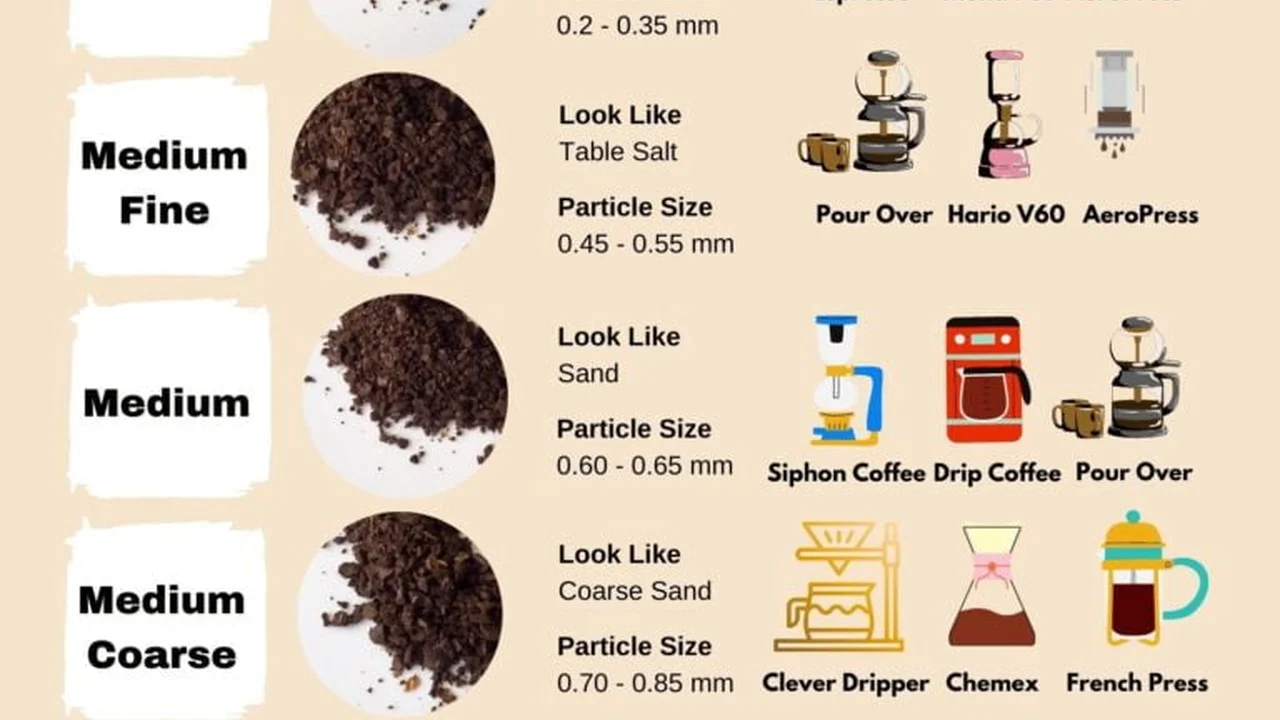
Appearance: Similar to rough sand. Still distinct particles, but smaller than coarse.
Brewing Methods:
- Chemex: The Chemex uses a thicker paper filter, which slows down the flow rate. A medium-coarse grind allows for proper extraction without clogging the filter or leading to a very slow drip. It helps achieve the clean, bright cup Chemex is known for.
- Clever Dripper: This immersion brewer combines elements of pour-over and French press. A medium-coarse grind works well because the coffee steeps for a few minutes before being released through a filter, requiring a balance between extraction speed and clarity.
Why it works: Provides a balanced extraction for methods with moderate contact times and often thicker filters that require a slightly slower flow.
Medium Grind for Drip Coffee Makers and Flat-Bottom Pour Overs
Appearance: Resembles regular sand. This is often the default setting on many pre-ground coffee bags.
Brewing Methods:
- Automatic Drip Coffee Makers: Most standard home drip coffee makers are designed for a medium grind. The contact time is moderate, and the filter (paper or permanent) can handle this particle size without clogging or letting too many fines through.
- Flat-Bottom Pour Overs (e.g., Kalita Wave): These brewers have multiple holes in the bottom, which allows for a more even extraction than cone-shaped pour-overs. A medium grind provides the right flow rate and extraction for a balanced cup.
Why it works: This is a versatile grind size, offering a good balance for common brewing methods with moderate flow rates and contact times.
Medium-Fine Grind for Cone-Shaped Pour Overs and Aeropress
Appearance: Finer than sand, but still gritty. Similar to table salt.
Brewing Methods:
- Cone-Shaped Pour Overs (e.g., Hario V60, Melitta): These brewers have a single, larger hole at the bottom, leading to a faster flow rate. A medium-fine grind is necessary to ensure sufficient extraction in the shorter contact time. If your V60 coffee tastes weak or sour, try going a bit finer.
- AeroPress (Standard Method): The AeroPress uses a short immersion time and often a quick plunge. A medium-fine grind allows for efficient extraction in this rapid process. Depending on your specific AeroPress recipe (inverted, longer steep), you might adjust slightly finer or coarser.
Why it works: The slightly finer particles increase surface area, speeding up extraction for methods with shorter contact times or faster flow rates.
Fine Grind for Espresso and Moka Pot
Appearance: Finer than table salt, almost like powdered sugar or flour, but still with a slight grittiness. When rubbed between your fingers, it feels like a fine powder.
Brewing Methods:
- Espresso: This is where grind size becomes absolutely critical. Espresso machines use high pressure and very short contact times (25-30 seconds). An extremely fine grind is essential to create enough resistance to the water flow, allowing for proper extraction under pressure. Too coarse, and your shot will be watery and fast (under-extracted). Too fine, and it will choke the machine, dripping slowly or not at all (over-extracted).
- Moka Pot: While not true espresso, the Moka Pot also uses pressure to force hot water through coffee grounds. A fine grind, slightly coarser than espresso but finer than drip, is ideal. Too fine, and it can clog; too coarse, and the coffee will be weak.
Why it works: The very small particles create significant resistance to water flow, allowing for rapid and efficient extraction under high pressure or with very short contact times.
Turkish Grind for Ibrik
Appearance: Extremely fine, like flour or powdered sugar. No discernible particles.
Brewing Methods:
- Turkish Coffee (Ibrik/Cezve): This method involves boiling finely ground coffee directly in water. The coffee is consumed with the grounds still in the cup. The ultra-fine grind is necessary for this unique brewing style, allowing the coffee to dissolve and create a thick, rich beverage.
Why it works: The extremely fine particles allow for maximum dissolution and a thick, unfiltered beverage where the grounds remain in the cup.
Recommended Grinders for Achieving Perfect Grind Sizes
To truly master grind size, you need a good quality grinder. Blade grinders are a no-go for serious coffee brewing as they chop beans inconsistently, leading to uneven extraction. You need a burr grinder, which grinds beans between two abrasive surfaces, producing a much more uniform particle size. Here are some top recommendations across different price points and types:
Entry-Level Manual Burr Grinders for Portability and Precision
Manual grinders are excellent for beginners, travel, or those on a budget. They offer surprising grind quality for their price.
-
Timemore C2/C3:
- Price: ~$60-$80 USD
- Use Case: Excellent for pour-over, AeroPress, and even decent for French press. Can handle espresso in a pinch, but requires more effort and consistency might vary.
- Comparison: Known for its sharp burrs and consistent grind for its price point. The C3 is an upgrade with improved burrs. It's a significant step up from cheaper manual grinders.
- Why it's great: Great value, portable, and produces a surprisingly uniform grind for its cost. Ideal for single servings.
-
1Zpresso JX-Pro / J-Max:
- Price: ~$160-$200 USD
- Use Case: The JX-Pro is a fantastic all-rounder, excelling at espresso, pour-over, and everything in between. The J-Max is specifically designed for espresso with finer adjustments.
- Comparison: These are premium manual grinders, often rivaling electric grinders in terms of grind quality and consistency, especially for espresso. They offer very precise grind adjustments.
- Why it's great: If you're serious about manual brewing or want a high-quality espresso grind without the electric grinder price tag, these are top contenders. Durable and built to last.
Mid-Range Electric Burr Grinders for Versatility
These grinders offer convenience and a good balance of performance for most home brewing methods.
-
Baratza Encore:
- Price: ~$180 USD
- Use Case: The go-to recommendation for entry-level electric grinders. Excellent for drip, pour-over, French press, and AeroPress. Not ideal for espresso due to insufficient fine adjustments.
- Comparison: Widely praised for its consistent grind quality for filter coffee and its robust build. Baratza also has excellent customer support and readily available spare parts.
- Why it's great: A reliable workhorse for daily brewing. It's easy to use and provides a significant upgrade from pre-ground coffee.
-
Fellow Ode Brew Grinder (Gen 2):
- Price: ~$345 USD
- Use Case: Designed specifically for filter coffee (drip, pour-over, French press, cold brew). The Gen 2 burrs offer a wider range and improved grind quality. Not suitable for espresso.
- Comparison: Known for its sleek design, quiet operation, and excellent grind consistency for non-espresso methods. It's a single-dose grinder, meaning you only grind what you need.
- Why it's great: If your focus is purely on filter coffee and aesthetics, the Ode Gen 2 is a fantastic choice. It produces very uniform grounds, leading to cleaner cups.
High-End Electric Burr Grinders for Espresso and All-Around Excellence
If espresso is your passion, or you simply want the best possible grind for any method, these are worth the investment.
-
Baratza Sette 270Wi:
- Price: ~$600 USD
- Use Case: Primarily an espresso grinder, offering incredibly fast grinding and precise, stepless micro-adjustments. The 'Wi' model includes Acaia weighing technology for grind-by-weight precision. Can also do coarser grinds for pour-over, but its strength is espresso.
- Comparison: Unique design with a straight-through grind path, minimizing retention. It's a powerhouse for espresso, known for its speed and accuracy.
- Why it's great: If you're serious about dialing in espresso shots with precision and speed, the Sette 270Wi is a top performer.
-
Eureka Mignon Specialita:
- Price: ~$650-$750 USD
- Use Case: An excellent all-purpose grinder, but truly shines for espresso. Offers stepless micrometric adjustment for incredibly fine-tuning.
- Comparison: Known for its quiet operation, robust build quality, and consistent grind. It's a popular choice for home baristas who want café-level performance.
- Why it's great: A solid, reliable, and quiet grinder that delivers exceptional grind quality for espresso and performs very well for other methods too.
Troubleshooting Your Grind Size: Taste and Visual Cues
Even with the right grinder, dialing in the perfect grind size is an ongoing process. Here's how to troubleshoot based on what you see and taste:
Under-Extraction Indicators
- Taste: Sour, acidic, weak, watery, thin body, grassy, or salty.
- Visual (Espresso): Shot pulls too fast (e.g., 15 seconds for 30g out), crema is thin and dissipates quickly, stream is pale and watery.
- Visual (Filter Coffee): Brew time is too short, water drains too quickly, bed of grounds looks unevenly extracted.
- Solution: Your grind is too coarse. Go finer.
Over-Extraction Indicators
- Taste: Bitter, astringent (drying sensation on the tongue), hollow, burnt, rubbery, or harsh.
- Visual (Espresso): Shot pulls too slow (e.g., 45+ seconds for 30g out), machine chokes, crema is dark and spotty, stream is thick and tar-like.
- Visual (Filter Coffee): Brew time is too long, water clogs and drains very slowly, bed of grounds looks muddy.
- Solution: Your grind is too fine. Go coarser.
Tips for Consistent Grinding and Better Coffee
- Always Use a Burr Grinder: This is non-negotiable for quality coffee. Blade grinders are inconsistent and create too many 'fines' (tiny particles) and 'boulders' (large particles), leading to uneven extraction.
- Grind Fresh: Coffee begins to lose its aroma and flavor compounds almost immediately after grinding. Grind your beans just before brewing for the best results.
- Start with Recommendations, Then Adjust: Use the general guidelines above as a starting point. Then, taste your coffee and make small adjustments to your grinder. It's often a process of trial and error.
- Consider Your Beans: Different beans (roast level, origin, freshness) can behave differently. Darker roasts are often more brittle and can produce more fines, sometimes requiring a slightly coarser grind. Lighter roasts might need a finer grind to extract fully.
- Clean Your Grinder Regularly: Old coffee oils and particles can build up in your grinder, affecting grind consistency and imparting stale flavors. Follow your grinder's cleaning instructions.
- Weigh Your Coffee: For ultimate consistency, always weigh your coffee beans before grinding. This eliminates variability in your dose.
- Keep Notes: Especially when dialing in espresso, keep a log of your grind settings, dose, yield, and taste notes. This will help you replicate good results and learn from less successful ones.
Mastering grind size is a journey, not a destination. Every new bag of beans, every slight change in humidity, can require a minor adjustment. But by understanding the principles of extraction and paying attention to the taste and visual cues of your brew, you'll be well on your way to consistently brewing incredible coffee at home. Happy grinding!
:max_bytes(150000):strip_icc()/277019-baked-pork-chops-with-cream-of-mushroom-soup-DDMFS-beauty-4x3-BG-7505-5762b731cf30447d9cbbbbbf387beafa.jpg)