Burr Grinder vs Blade Grinder Which is Better
Understand the fundamental differences between burr and blade coffee grinders. Learn why burr grinders are superior for quality coffee.
Understand the fundamental differences between burr and blade coffee grinders. Learn why burr grinders are superior for quality coffee.
Burr Grinder vs Blade Grinder Which is Better
Hey there, fellow coffee lovers! Ever wondered what makes your morning brew taste so good, or sometimes, not so good? A huge part of that magic happens even before the water touches the coffee grounds: it's all about the grind. And when it comes to grinding coffee at home, you've essentially got two main contenders: burr grinders and blade grinders. Now, if you're serious about your coffee, you've probably heard whispers that one is far superior to the other. Let's dive deep and figure out why, and which one is truly better for your home barista setup.
Coffee Grinder Basics Understanding the Grind
Before we get into the nitty-gritty of burrs versus blades, let's talk about why the grind matters so much. Coffee extraction is a delicate dance between water and coffee particles. If your grind is too coarse, the water passes through too quickly, resulting in under-extracted coffee that tastes weak, sour, or watery. Think of it like trying to make tea with huge chunks of tea leaves – not much flavor comes out. On the flip side, if your grind is too fine, the water struggles to pass through, leading to over-extracted coffee that tastes bitter, harsh, or even burnt. Imagine trying to push water through fine sand – it's a struggle, and you'll get a muddy mess.
The goal is a consistent grind size. This means all your coffee particles are roughly the same size, allowing for even extraction. When extraction is even, you get a balanced, flavorful cup that truly showcases the coffee's potential. This consistency is where burr grinders really shine, and where blade grinders often fall short.
Blade Grinders The Whirring Chopper
How Blade Grinders Work Coffee Chopping Mechanism
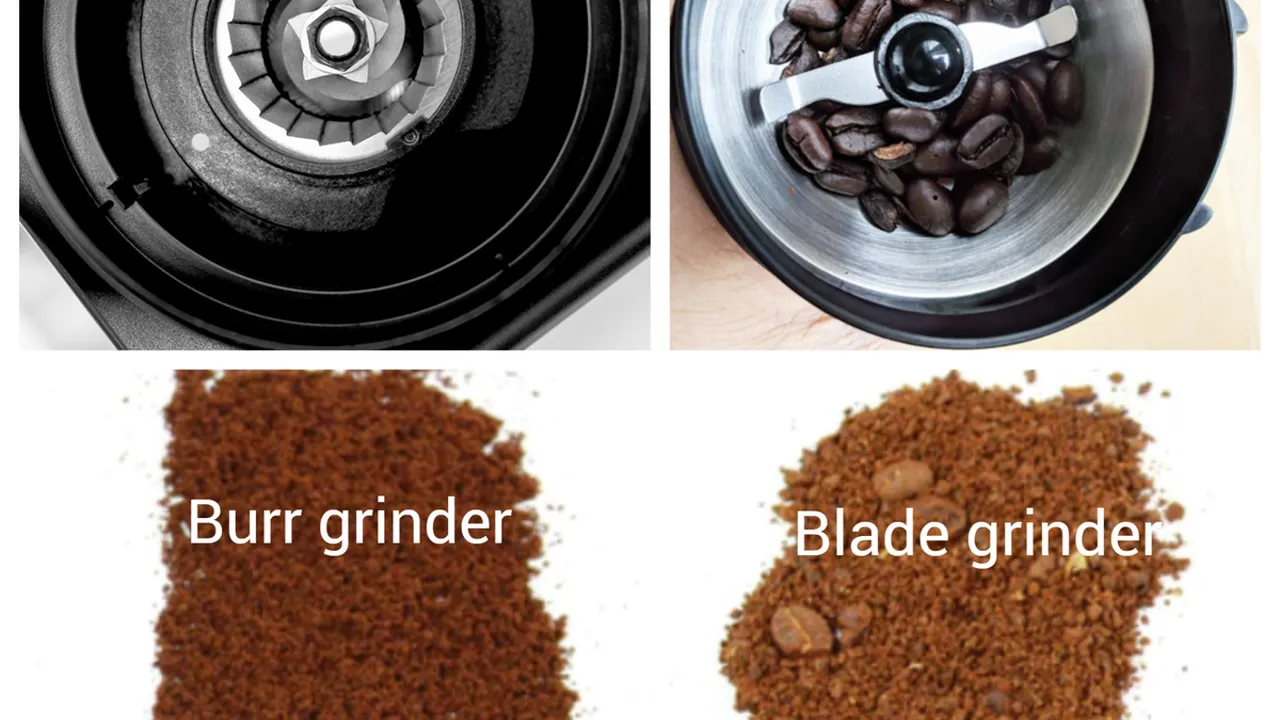
Let's start with the more common, and often cheaper, option: the blade grinder. You probably have one of these lurking in your kitchen cabinet, perhaps even labeled as a 'spice grinder.' And that's a pretty accurate description of how it works. A blade grinder uses a rapidly spinning blade, similar to a propeller, to chop and smash coffee beans. You press a button, the blades whir, and your beans get pulverized.
Blade Grinder Pros and Cons Affordability and Inconsistency
The biggest pro of a blade grinder is its price. They are incredibly affordable, making them an accessible entry point for anyone looking to grind their own coffee at home. They're also compact and easy to store. However, that's pretty much where the advantages end when it comes to coffee.
The major con, and it's a big one, is inconsistency. Because the blades chop rather than grind, you end up with a wide range of particle sizes. You'll have some fine powder, some medium chunks, and even some larger pieces that escaped the blades. This unevenness leads to uneven extraction. The fine particles will over-extract, contributing bitterness, while the coarse particles will under-extract, leading to sourness. The result? A muddy, unbalanced, and often unpleasant cup of coffee.
Another issue is heat. The high-speed chopping action generates friction and heat, which can 'cook' your coffee beans even before brewing. This can degrade the delicate aromas and flavors, leaving you with a duller taste. Plus, the static electricity generated can make a mess, with coffee grounds clinging to everything.
When to Use a Blade Grinder Limited Applications
Honestly, for coffee, we'd recommend avoiding blade grinders if you can. They are simply not designed for precision coffee grinding. If you absolutely must use one, perhaps for a very coarse grind for cold brew where consistency is slightly less critical, or if it's all you have, then go for it. But for any other brewing method, especially espresso or pour-over, a blade grinder will severely limit the quality of your coffee.
Burr Grinders The Precision Grinding Solution
How Burr Grinders Work Coffee Grinding Mechanism
Now, let's talk about the star of the show: the burr grinder. Unlike blade grinders, burr grinders actually grind coffee beans between two abrasive surfaces, or 'burrs.' These burrs are typically made of ceramic or steel. The beans are fed between these burrs, and as they rotate, they crush and shear the beans into consistently sized particles. You can adjust the distance between the burrs to achieve different grind sizes, from very coarse for French press to super fine for espresso.
Types of Burr Grinders Flat Burr vs Conical Burr
Within the world of burr grinders, you'll encounter two main types: flat burr and conical burr. Both are excellent, but they have subtle differences:
- Flat Burr Grinders: These grinders have two flat, parallel burrs that face each other. Coffee beans are fed into the center and then pushed outwards as they are ground. Flat burrs are known for producing a very uniform particle size distribution, which can lead to a clean, bright cup. However, they can retain a bit more coffee grounds (retention) and might be a bit louder.
- Conical Burr Grinders: These grinders use two cone-shaped burrs, one inside the other. The beans are ground as they travel down through the cone. Conical burrs are generally quieter, have less retention, and are often preferred for espresso due to their ability to produce a fluffy, consistent grind. They might produce a slightly wider particle distribution than flat burrs, but still vastly superior to blade grinders.
For most home baristas, either flat or conical burrs will provide a significant upgrade over blade grinders. The choice often comes down to personal preference, budget, and specific brewing methods.
Burr Grinder Pros and Cons Consistency and Control
The overwhelming advantage of burr grinders is consistency. They produce a uniform grind size, which is crucial for even extraction and a delicious cup of coffee. This consistency gives you control over your brew, allowing you to fine-tune your grind for different brewing methods and achieve optimal flavor.
Burr grinders also generate less heat than blade grinders, preserving the delicate aromatics of your coffee. Many models offer a wide range of grind settings, from coarse to fine, giving you versatility for various brewing techniques like French press, pour-over, drip, and espresso.
The main con is the price. Burr grinders are more expensive than blade grinders, but consider it an investment in your coffee quality. They also tend to be larger and heavier, taking up more counter space.
Recommended Burr Grinders for Every Budget and Brewing Style
Alright, now that you're convinced a burr grinder is the way to go, let's look at some specific recommendations. We'll cover options for different budgets and use cases, from entry-level electric grinders to more advanced manual and electric models.
Entry Level Electric Burr Grinders Great Value Options
If you're just starting out and want a significant upgrade without breaking the bank, these are excellent choices:
Baratza Encore Conical Burr Coffee Grinder
Price Range: $150 - $180 USD
Use Case: This is often considered the gold standard for entry-level electric burr grinders. It's incredibly versatile and perfect for drip coffee, French press, AeroPress, and even decent pour-over. While it can grind fine enough for some espresso machines, it might struggle with the very fine, consistent grind required for high-end espresso machines.
Key Features:
- 40 grind settings, offering a wide range from fine to coarse.
- Conical burrs for consistent grinding and minimal heat.
- Easy to use with a simple on/off switch.
- Durable build quality, and Baratza has excellent customer support and readily available replacement parts.
Comparison: The Encore is a workhorse. It's reliable, produces a consistent grind for most brew methods, and is built to last. It's a significant step up from any blade grinder and will immediately improve your coffee.
Capresso Infinity Conical Burr Grinder
Price Range: $100 - $130 USD
Use Case: Another fantastic entry-level option, the Capresso Infinity is known for its quiet operation and consistent grind. It's great for drip, French press, and pour-over. Similar to the Encore, it can do espresso in a pinch but isn't its strong suit.
Key Features:
- 16 grind settings, with four main categories (extra fine, fine, regular, coarse).
- Conical burrs designed for precision and minimal static.
- Safety lock system.
- Relatively quiet operation.
Comparison: The Capresso Infinity is often compared to the Baratza Encore. It's slightly more affordable and often praised for being quieter. Both are excellent choices for beginners, with the Encore perhaps having a slight edge in grind consistency at the finer end of the spectrum.
Mid Range Electric Burr Grinders Enhanced Performance
If you're ready to invest a bit more for better performance, especially if you're dabbling in espresso or want more control, these are great options:
Breville Smart Grinder Pro Conical Burr Grinder
Price Range: $200 - $280 USD
Use Case: This grinder is a popular choice for home baristas who want versatility and precision. It's excellent for all brew methods, including espresso, thanks to its wide range of micro-adjustable settings. It pairs well with Breville's espresso machines.
Key Features:
- 60 precise grind settings, plus an adjustable upper burr for even more fine-tuning.
- Conical burrs.
- LCD display with programmable shot time/cups.
- Dosing IQ technology for precise dosing.
- Comes with two portafilter cradles (small and large) and a grinds container.
Comparison: The Smart Grinder Pro offers significantly more control and features than entry-level grinders. Its ability to grind fine enough for espresso consistently makes it a strong contender for those with espresso machines. The digital display and programmable settings add convenience.
Rancilio Rocky Doserless Coffee Grinder
Price Range: $350 - $450 USD
Use Case: Often paired with Rancilio Silvia espresso machines, the Rocky is a robust and reliable grinder primarily designed for espresso. It's also capable of grinding for other methods, but its strength lies in its espresso performance.
Key Features:
- 50mm commercial-grade flat burrs.
- 50 grind settings.
- Heavy-duty construction, built to last.
- Powerful motor.
Comparison: The Rancilio Rocky is a step up in build quality and motor power. It's a more 'prosumer' level grinder, meaning it bridges the gap between home and commercial equipment. While it has fewer settings than the Breville, its larger, commercial-grade burrs often translate to a more consistent and fluffy espresso grind. It's a bit of a tank, built for durability.
High End Electric Burr Grinders Professional Home Barista
For the serious home barista who demands the best and is willing to invest, these grinders offer commercial-grade performance:
Niche Zero Single Dose Conical Burr Grinder
Price Range: $600 - $700 USD
Use Case: The Niche Zero has taken the home barista world by storm, especially for espresso enthusiasts. It's a single-dose grinder, meaning you weigh out your beans for each shot, eliminating retention and ensuring maximum freshness. It excels at espresso but also produces excellent grinds for pour-over and other methods.
Key Features:
- 63mm conical burrs (Mazzer Kony burrs).
- Near-zero retention, meaning almost no old coffee grounds are left behind.
- Stepless grind adjustment for infinite precision.
- Quiet operation.
- Premium build quality with a sleek design.
Comparison: The Niche Zero is a game-changer for single-dosing. Its low retention and stepless adjustment make it incredibly precise for espresso. If you value freshness and consistency above all else, and you're willing to single dose, this is a top-tier choice. It's a different beast compared to hopper-fed grinders.
Eureka Mignon Specialita Flat Burr Grinder
Price Range: $500 - $700 USD
Use Case: The Eureka Mignon Specialita is a compact yet powerful espresso-focused grinder. It's known for its quiet operation, excellent grind quality for espresso, and user-friendly touchscreen interface. While primarily for espresso, it can handle other methods too.
Key Features:
- 55mm flat burrs.
- Stepless micrometric adjustment for extreme precision.
- Touchscreen display with two programmable doses.
- Silent Technology for very quiet grinding.
- Anti-Clump & Electrostatic system for fluffy grounds.
Comparison: The Specialita is a fantastic choice for espresso lovers who want a high-performance, quiet, and compact grinder. Its stepless adjustment and flat burrs deliver excellent espresso grinds. It's a direct competitor to the Niche Zero, with the main difference being its hopper-fed design versus the Niche's single-dose approach.
Manual Burr Grinders Portability and Precision
Don't overlook manual burr grinders! They're fantastic for travel, small spaces, or if you enjoy the ritual of hand grinding.
Timemore Chestnut C2 Manual Coffee Grinder
Price Range: $60 - $80 USD
Use Case: An incredibly popular and highly-rated manual grinder for its price. It's excellent for pour-over, AeroPress, and French press. It can grind fine enough for espresso, but it will take some effort.
Key Features:
- CNC stainless steel conical burrs.
- Stepped grind adjustment.
- Aluminum alloy body, compact and durable.
- Smooth grinding action.
Comparison: The Timemore C2 offers incredible value. It provides a consistent grind far superior to any blade grinder, and it's portable. It's a great entry point into manual grinding without a huge investment.
Comandante C40 MK4 Nitro Blade Grinder
Price Range: $250 - $300 USD
Use Case: Considered by many to be the best manual grinder on the market. It excels at all brew methods, from French press to espresso, delivering exceptional grind consistency and clarity of flavor.
Key Features:
- Patented Nitro Blade conical burrs (high-alloy stainless steel).
- Stepped grind adjustment with precise clicks.
- Robust and durable construction.
- Ergonomic design for comfortable grinding.
Comparison: The Comandante is a premium manual grinder. Its burrs are incredibly sharp and durable, producing an exceptionally uniform grind. If you're serious about manual grinding or need the absolute best portable option, the Comandante is worth the investment. It's a joy to use and delivers results comparable to high-end electric grinders.
Choosing the Right Grinder for Your Home Barista Setup
Consider Your Brewing Methods Grind Size Requirements
The first thing to consider is what kind of coffee you'll be making. Different brewing methods require different grind sizes:
- French Press: Requires a very coarse, uniform grind.
- Cold Brew: Also needs a coarse grind.
- Drip Coffee Makers: Typically a medium grind.
- Pour-Over (e.g., Chemex, V60): Medium-fine to medium grind, with consistency being key.
- AeroPress: Very versatile, can use anything from fine to medium-coarse.
- Espresso: Requires a very fine, consistent, and fluffy grind. This is the most demanding method for a grinder.
If you're primarily making drip coffee or French press, an entry-level burr grinder like the Baratza Encore will be perfectly adequate. If espresso is your passion, you'll need to invest in a grinder specifically designed for that, like the Breville Smart Grinder Pro, Rancilio Rocky, Niche Zero, or Eureka Mignon Specialita.
Budget Considerations Investment in Flavor
As we've seen, burr grinders range significantly in price. While a blade grinder might cost you $20-$30, a good entry-level burr grinder starts around $100-$150. High-end models can easily go upwards of $500-$700. Think of your grinder as an investment. It's arguably the most important piece of equipment after your coffee beans themselves. A great grinder can make mediocre coffee taste better, but a bad grinder will make even the best beans taste terrible.
Space and Noise Level Practical Considerations
Consider how much counter space you have. Electric burr grinders can be bulky. If space is an issue, a compact electric grinder like the Eureka Mignon series or a manual grinder might be a better fit. Also, think about noise. Some grinders are louder than others. If you're an early riser and don't want to wake the whole house, look for models known for quiet operation, like the Capresso Infinity or Eureka Mignon Specialita.
Ease of Use and Cleaning Maintenance Tips
How easy is the grinder to use and clean? Most electric burr grinders are straightforward, with simple controls. Cleaning involves brushing out residual grounds and occasionally disassembling the burrs for a deeper clean. Manual grinders are generally easier to clean due to fewer electronic components. Regular cleaning is crucial to prevent old coffee oils from building up and affecting the taste of your fresh grounds.
The Verdict Burr Grinders Win Every Time
So, to answer the big question: burr grinder vs. blade grinder, which is better? For quality coffee, the burr grinder wins, hands down, every single time. It's not even a close contest. A blade grinder is a chopper, creating an inconsistent mess of coffee particles that leads to uneven extraction and a sub-par cup. A burr grinder is a precision tool, designed to produce uniform grounds that unlock the full flavor potential of your coffee beans.
If you're serious about improving your home coffee experience, investing in a good burr grinder is the single most impactful upgrade you can make. It will transform your daily ritual and allow you to truly taste the nuances and complexities of your favorite beans. So, ditch that blade grinder, embrace the burr, and get ready for some seriously delicious coffee!
:max_bytes(150000):strip_icc()/277019-baked-pork-chops-with-cream-of-mushroom-soup-DDMFS-beauty-4x3-BG-7505-5762b731cf30447d9cbbbbbf387beafa.jpg)